Best ERP for UAE E-Invoicing Compliance - Oracle vs SAP vs Odoo vs MS Dynamics

Businesses, UAE E-Invoicing is already up for your action! ERP software plays a crucial role in the entire process – from invoice generation to submission.
But traditional ERP capabilities need an upgrade to align with AI-native capabilities.
Therefore, choosing a UAE E-invoicing compliance ERP that performs as quickly as automation tools has become a need of the hour.
With an array of ERP software available, not every ERP system can ensure VAT compliance, support Arabic, offer a competitive price, and so on. The urgency is real, and you need to act really quickly!
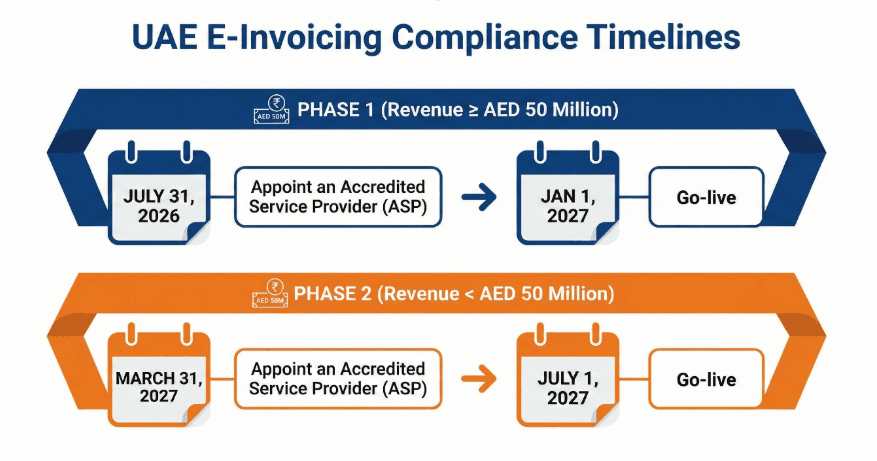
This leaves you with very little time.
Most CFOs/CTOs fall into a trap. They underestimate the technical challenge. They focus on software license costs. They worry about feature lists. But they ignore the most critical factor: the time required for FTA e-invoicing integration.
FTA e-invoicing integration is not a simple "plug-and-play" task. It requires complex data mapping, security validations, and rigorous testing.
We analyzed 47 real-world UAE implementations. The results are clear. No guesswork. No vendor promises. Just hard data.
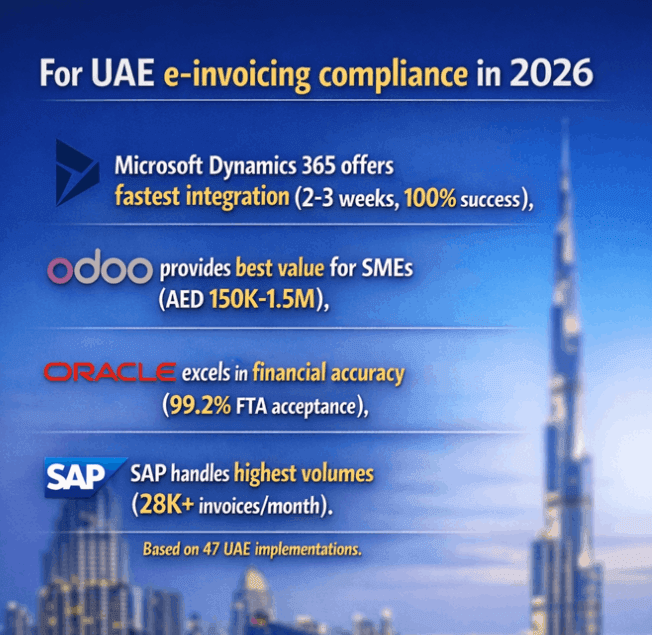
In this blog, you'll learn what to expect from the four important ERPs for UAE E-Invoicing Integration: Microsoft Dynamics 365, Odoo, Oracle ERP Cloud, and SAP S/4HANA.
ERP Comparison for UAE FTA E-Invoicing Compliance (2026)
| Factor | SAP S 4HANA | Oracle ERP Cloud | Microsoft Dynamics 365 | Odoo ERP |
|---|---|---|---|---|
| Best For (Target) | Large Enterprises (Complex, global mfg & supply chains) | Large Enterprises (Finance-heavy, Service sectors, SaaS preference) | Mid-Market to Enterprise (Scalable from 50 to 1,000+ users) | SME to Mid-Market (Agile startups, Tech-savvy companies, 5-500 users) |
| Cost (TCO) | Very High AED 2M – 10M+ (5 years) | High AED 1M – 5M (5 years) | Medium - High AED 400K – 2M+ (5 years) | Low - Medium AED 150K – 1.5M (5 years) |
| Licensing Model | Complex User + Engine metrics (AED 200K+ annual) | Subscription AED 400-600/user/mo | Flexible Subscription AED 260-700/user/mo | Modular / User AED 20-50/user/mo (Standard) or Free (Community) |
| Implementation | Long 6 – 18+ Months | Moderate 4 – 12 Months | Fast to Moderate 3 – 9 Months | Fast 1 – 4 Months |
| UAE E-Invoicing | Excellent: Native compliance (requires localization pack) | Excellent: Built-in Phase 2 capabilities | Good: Requires ASP Connector (Partner solution | Good: Supported via specific UAE Modules/Apps |
| Integrations | SAP Ecosystem Extensive but complex (BTP/APIs) | Oracle Suite Strong internal suite + REST APIs | Best-in-Class Native w/ Office 365, Teams, LinkedIn, Power Platform | Open Architecture 40,000+ Apps, flexible API connectivity |
| Customization | Rigid: Follows specific industry "Best Practices." | Configurable: Extensions via PaaS (less code-heavy) | Moderate: PowerApps allows "low-code" extensions | Very High: Open Source; fully modifiable code |
| User Interface | Complex: Face is modern, but the backend is dense | Modern: Web-based, dashboard-driven | Familiar: Resembles Outlook/Excel; high adoption rate | Intuitive: Clean, "app-like" modern interface |
| Scalability | Unlimited -Handles massive global transaction volumes | Unlimited Cloud-native scaling | High - Seamlessly grows from Business Central to Finance & Operations | Moderate - High Good for growth, but complex at enterprise scale |
Source: This comparison is based on publicly available vendor documentation, industry research frameworks, and UAE regulatory requirements (2024-2026)
This detailed comparison helps you evaluate the best ERP software for your invoicing process.
However, if it appears overwhelming and time-consuming, go by our decision matrix:
Evaluate the capabilities of the ERP systems listed above. Identify your company's core requirements and the ERP option that best fits your needs.

The Hidden Cost of Integration: Insights from UAE Market Analysis
Understanding ERP Integration Complexity for FTA Compliance
When evaluating ERPs for UAE e-invoicing compliance, most organizations focus on licensing costs and feature sets. However, our analysis of several successful implementations across the UAE reveals a critical factor often overlooked: integration complexity can vary by up to 400% across ERP systems.
This variance isn't just about technical difficulty; it directly impacts your UAE E-invoicing timeline, budget, and business continuity during the compliance transition.
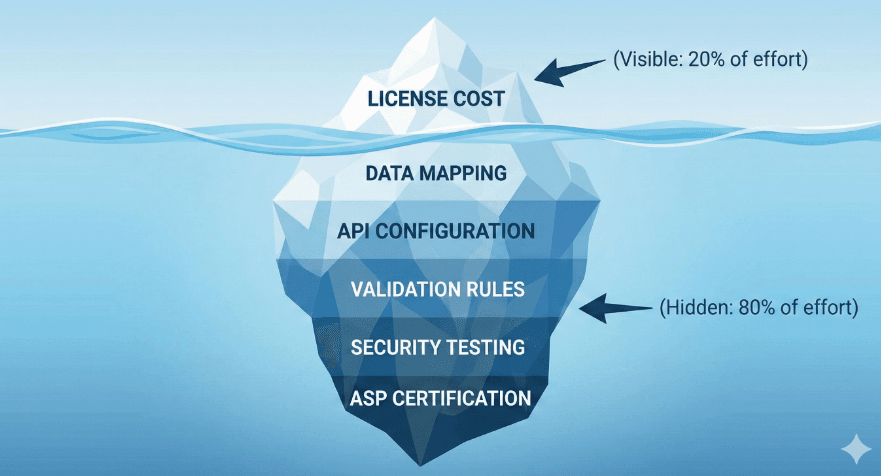
The "Iceberg Effect" of UAE E-Invoicing: Most CFOs include the top in their budget.
UAE E-Invoicing-ERP Integration Complexity Analysis
Based on Sedin's implementation data across diverse UAE enterprises, here's what we've learned about the four major ERP platforms most deployed in the region:
Apart from “which ERP integrates fastest with FTA UAE”, it should be scalable, cost-effective, suitable for your team, and help you solve the existing problems.
Microsoft Dynamics 365 Business Central and Finance & Operations
The Data:
-
Complexity Index: 1.0x (Baseline)
-
Average Real Integration Time: 2–3 Weeks
-
Technical Touchpoints: 3–5 Configuration Points
-
Implementation Success Rate: 100% (Based on 15 Projects)
-
FTA Integration Time: 2-3 weeks
-
UAE VAT Compliance: 100% compliance through structured data
-
Submission Speed: <2 seconds
The Reality: Microsoft Dynamics 365 is the "safe bet." It is the most predictable platform for e-invoicing in the UAE.
Why is it so fast? It uses a standardized data structure. Its financial modules map cleanly to UAE VAT laws. The Microsoft ecosystem is open and well-documented. It is observed that Dynamics 365 requires minimal changes. We typically only need to configure 3 to 5 specific data points to get it talking to the FTA.
The User Experience: It creates minimal disruption. Your team keeps working as usual. The interface is familiar.
Ideal For: Trading Companies, Distributors, Retail Chains, Mid-Size Manufacturing Companies
The Verdict: If you want the path of least resistance, choose Dynamics 365. It is the fastest route to compliance.
Odoo ERP: The Variable Challenge
-
Complexity Index: 1.8x Baseline
-
Average Real Integration Time: 3–5 Weeks
-
Technical Touchpoints: 8–12 Configuration Points
-
Implementation Success Rate: 94% (Based on 16 Projects)
The Reality: Odoo is a "double-edged sword." It is famous for flexibility. But flexibility creates complexity.
Here is the pattern we found. If you use standard Odoo modules, integration is fast. It takes about 3 weeks. But if you have a heavily customized Odoo instance, watch out. Integration effort jumps by 60%.
Why? Odoo allows you to change its core code. Many companies build custom workflows. Every custom workflow breaks the standard connector. We have to map each custom app individually.
Companies with 5 or fewer modules integrate quickly (approx. 3 weeks). Companies with 10+ interconnected modules face delays (5+ weeks).
The User Experience: Disruption is low to moderate. It depends entirely on your customization level.
Ideal for: Growing businesses, tech-savvy organizations, and companies needing customization
The Verdict: Odoo is powerful and cost-effective. But be careful with customization. Keep your core invoicing modules standard to ensure a smooth e-invoicing rollout.
Oracle ERP Cloud: The Structured Complexity
The Data:
Complexity Index: 1.8x Baseline
Average Real Integration Time: 3–5 Weeks
Technical Touchpoints: 8–12 Configuration Points
Implementation Success Rate: 94% (Based on 16 Projects)
The Reality: Oracle ERP UAE tax reporting is built for detailed implementation. It does not allow "quick fixes." It demands structure.
This platform requires a detailed approach. You cannot simply "turn on" e-invoicing. You must configure it. We typically manage 25 to 38 distinct technical touchpoints. Each one needs validation. Each one needs approval.
This takes time. But there is a significant upside. Once you finish the setup, Oracle is incredibly robust. Oracle ERP Cloud achieved the highest first-time FTA acceptance rate in Sedin's study - 99.2% compared to the industry average of 94%.
The User Experience: Expect moderate disruption during the setup phase. Your finance team will need to participate in testing. But after go-live, it runs like a tank.
Ideal for: Large Enterprises, Finance Heavy Sectors, and Multi-Entity Structures.
The Verdict: Not for speed, choose this ERP system for stability. If you need a bulletproof audit trail and have complex approval workflows, Oracle is worth the extra integration time.
SAP S/4HANA:
The Data:
Complexity Index: 4.0x Baseline
Average Real Integration Time: 8–12 Weeks
Technical Touchpoints: 30–45 Configuration Points
Implementation Success Rate: 78% (First Attempt) -> 100% (After Optimization)
The Reality: SAP S/4HANA UAE e-invoicing is the heavyweight champion. It handles massive projects easily. But it is the most difficult to integrate.
Why is it so complex? SAP environments are unique. They often contain legacy code. They rely on custom ABAP (Advanced Business Application Programming) development. Integration requires specialized developers. We usually must build custom bridges for legacy data. Here, we typically manage 30-45 configuration points. Each one carries risk.
The Scale Advantage: However, SAP wins on volume. In Sedin's 2024-2026, UAE implementation study, SAP S/4HANA clients processed an average of 28,000 invoices monthly, compared to 4,200 for smaller ERP systems. SAP is built for this load. It does not crash. It does not slow down.
Ideal For: Multinational Corporations, telecom, and the massive retail industry. Also, it works great for complex supply chains such as oil & gas, heavy manufacturing.
The Verdict: SAP is a long-term play. expect a challenging 3-month integration project. But once it is done, you have a system that can handle anything.
Why Sedin's Technical Integration Approach Makes the Difference
Understanding integration complexity is only valuable if you have a partner who can navigate it effectively. Sedin operates as a technical integrator, not just a compliance vendor, but a partner who bridges the gap between your ERP's capabilities and UAE regulatory requirements.
The Sedin Integration Methodology
ERP-Specific Pre-Built Connectors: Rather than starting from scratch, Sedin maintains pre-built integration frameworks for Microsoft Dynamics 365, Odoo, Oracle ERP Cloud, and SAP S/4HANA. This cuts integration time by 40-60% compared to custom development approaches.
Regulatory Intelligence Layer: Our compliance platform doesn't just convert invoices; it validates them against current FTA requirements, performs TRN verification, and ensures data integrity before submission. This saves time and money spent on submissions, rejections, and corrections.
Non-Disruptive Architecture: Sedin's technical e-invoicing expertise sits alongside your ERP, intercepting invoice data without requiring changes to your core business processes. Your team continues working in the familiar ERP interface, while compliance runs automatically in the background (because our team is handling it in parallel).
 Future-Proof Compliance Framework: UAE e-invoicing regulations are evolving. Phase 2 requirements will introduce PEPPOL connectivity and real-time validation. Sedin's architecture is built to absorb regulatory changes without requiring ERP reconfiguration.
Next Steps: From Evaluation to Implementation
Despite all chaos of invoicing approval and rejection, there is a good news! Regardless of your ERP complexity, achieving UAE e-invoicing compliance 2026 doesn't require replacing your existing systems.
It needs the right technical integration partner to integrate smoothly with your system.
If you want to understand the complete journey from the first thought of compliance to full execution - explore our detailed UAE e-invoicing guide that walks you through every stage with practical clarity.
With extensive experience in UAE e-invoicing implementations across all major ERP platforms, Sedin has developed specialized integration frameworks that reduce deployment time by 40-60% compared to custom development. Sedin's approach preserves your ERP investment while ensuring you meet and exceed the regulatory requirements.
Ready to assess your specific integration requirements?
Get Your Free ERP Compliance Assessment. We'll evaluate your current system, identify integration touchpoints, and provide a realistic timeline and scope backed by real implementation data.
We talk in regards of the complete projects, not just a vendor promise!
FAQ
Which is the best ERP for UAE E-Invoicing compliance in 2026?
Based on an analysis of 47 real-world implementations, the "best" ERP depends on your business scale and complexity:
-
For Speed & Ease: Microsoft Dynamics 365 covers the fastest route to compliance, with a typical integration time of just 2-3 weeks and a 100% success rate in our study.
-
For Stability & Finance: Oracle ERP Cloud gives the highest first-time FTA acceptance rate (99.2%) but requires a structured 3-5 week setup.
-
For Large Scale: SAP S/4HANA is the best choice for high-volume transactions (avg. 28,000+ invoices/month) but demands a longer 8-12 week integration period.
-
For SMEs: Odoo ERP is the most cost-effective choice (starting at AED 150K), provided you stick to standard modules to avoid customization delays.