UAE E-Invoicing: Why Your ASP Choice Matters More Than Your Deadline
You already know the mandate is real. You've seen the timelines. Your CFO has probably flagged it in the last two board meetings.
The question isn't whether you need an Accredited Service Provider. It's whether the one you pick will actually work—with your ERP, your invoice volumes, your multi-entity structure, and the way your finance team actually operates day to day.
Because here's what nobody's saying loudly enough: the wrong ASP is worse than a late ASP. A bad pick means re-integration, invoice rejections in production, month-end reconciliation nightmares, and eventually ripping the whole thing out under even more time pressure.
You've got roughly 90 days before the 31 July 2026 appointment deadline if you're a large business. Let's make them count.
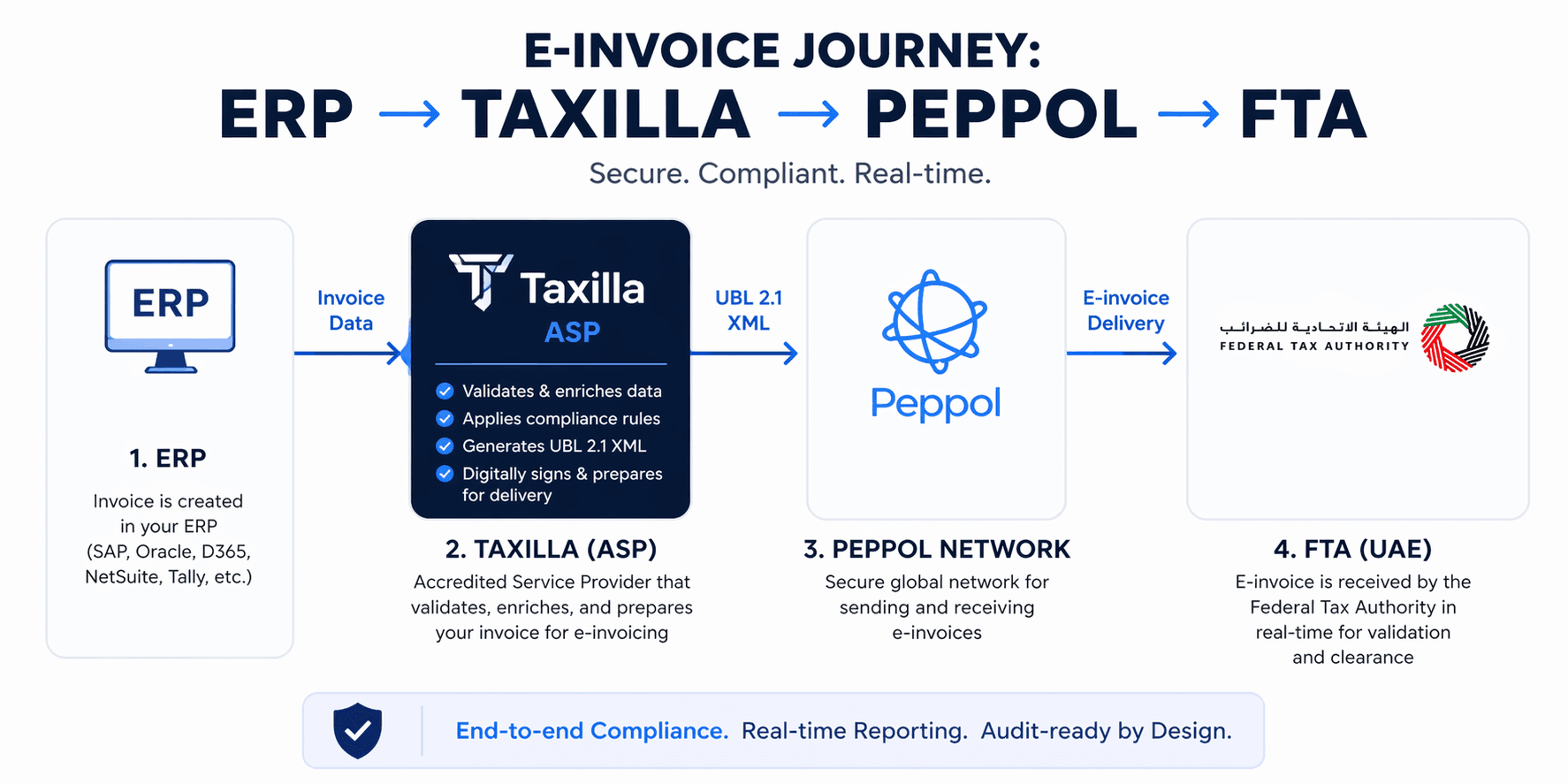
At Sedin, we're the technology implementation partner of Taxilla—a MoF pre-approved ASP and certified Peppol Access Point. Taxilla handles the compliance platform. We handle everything else: ERP readiness, data mapping, integration, testing, go-live, and ongoing support. End-to-end. One engagement, one team, no gaps between "the platform works" and "it works in your environment."
Here's what that looks like in practice—and what you should demand from whoever you choose.

The Real Problem Isn't the Deadline. It's What Happens After.
Most of the content out there is focused on explaining what an ASP is and when the deadline hits. You already know all that.
What you probably don't know—because it only becomes obvious in implementation—is where things actually break:
Your ERP isn't e-invoice-ready. It generates invoices, sure. But structured PINT-AE XML with UUIDs, Peppol routing, and real-time FTA transmission? That's a different game entirely. If your ASP doesn't have a native connector to your ERP, your team is building custom middleware. That's 3-6 months of dev work you don't have.
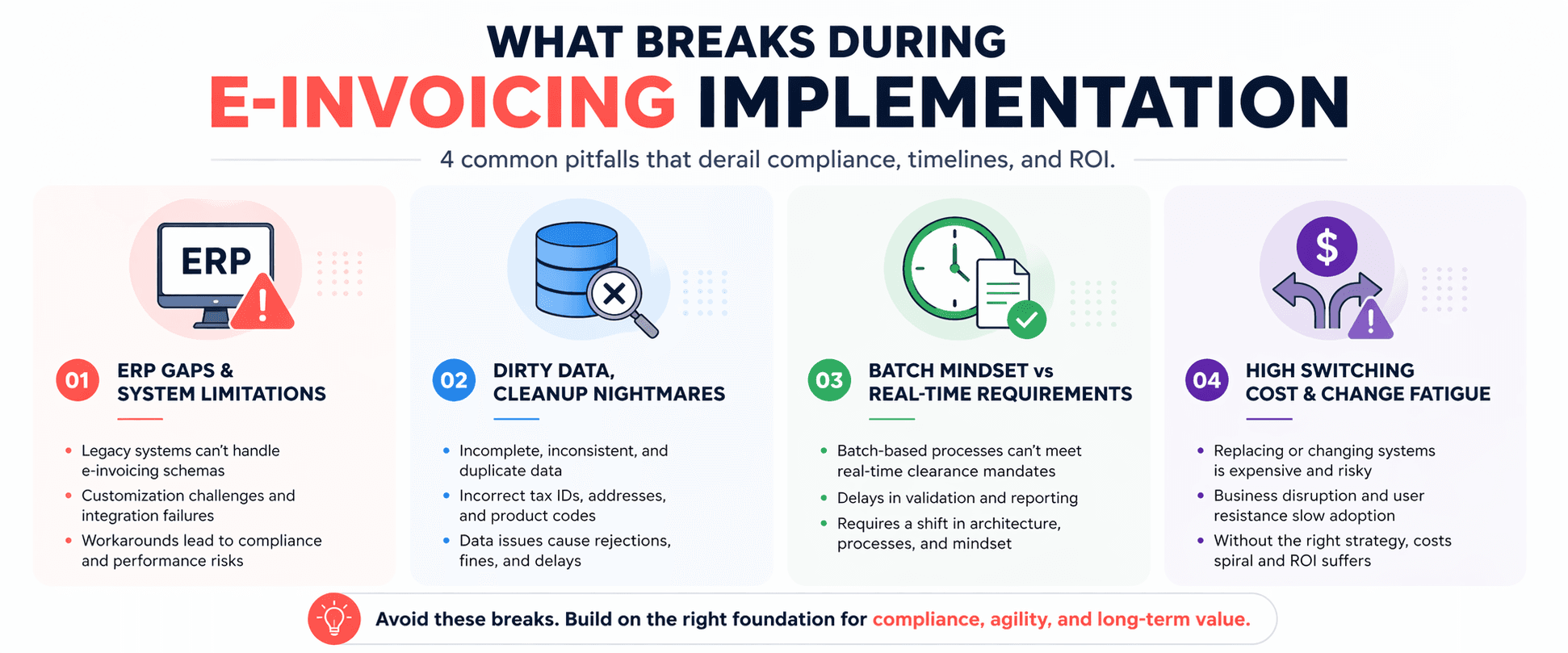
Your invoice data is messier than you think. Mandatory fields under PINT-AE are specific—buyer/seller Peppol IDs, TRN-derived participant identifiers (format: 0235 + first 10 digits of your TRN), line-level tax breakdowns, and more. Most ERP setups don't map cleanly to this. Data remediation alone can take weeks.
Batch processing won't cut it. The UAE model requires near real-time transmission. If your ASP only supports batch uploads or flat-file imports, you're already behind the compliance curve before you go live.
Switching ASPs post-appointment is painful. It's technically possible, but it means re-integration, re-testing, disruption to live flows, and the same evaluation cycle all over again—except now you're doing it under production pressure.
This is why the selection decision matters more than the selection speed.
What Separates an ASP That Works from One That Just Checks the Box
We've seen this play out across multiple CTC markets—Saudi Arabia, India, Malaysia, Australia. The pattern is always the same: businesses that treated ASP selection as a procurement checkbox ended up re-implementing within 18 months.
Here's what to actually pressure-test:
Does the ASP have prebuilt ERP connectors—or just a generic API?
There's a massive difference. A generic REST API means your team maps every field, handles every edge case, and builds every error-handling workflow from scratch. A prebuilt connector for SAP, Oracle, Microsoft Dynamics, or Workday means validated field mapping, tested exception handling, and go-live in weeks rather than months.
Taxilla, for example, has pre-built connectors with major ERPs and has been deployed within Microsoft Dynamics 365 Business Central with zero-portal, zero-export workflows—invoices flow directly from the ERP to the FTA without your finance team touching a separate system.
Is the ASP a certified Peppol Access Point—or just "Peppol-compatible"?
Compatibility isn't certification. The UAE five-corner model requires your ASP to be a certified Peppol Access Point and SMP that has completed OpenPeppol conformance testing. If they can't show you their certification, they can't operate as your ASP in production.
Have they actually done this before—in markets that matter?
The UAE isn't the first CTC mandate. Saudi Arabia's ZATCA rollout, India's GST e-invoicing, Australia's Peppol adoption, Malaysia's IRBM mandate—all followed similar patterns. An ASP with multi-country deployment experience has already solved the problems you're about to hit: data quality issues, ERP edge cases, multi-entity complexity, change management.
An ASP doing this for the first time is learning on your timeline. You don't want to be someone's pilot project when compliance is on the line.
Can it scale across your actual business structure?
If you operate across multiple legal entities, free zones, or GCC jurisdictions, you need an ASP that supports multi-entity, multi-jurisdiction setups natively—not one that requires a separate instance per entity. Ask about consolidated dashboards, cross-entity reporting, and how they handle different compliance rules per jurisdiction.
Why Sedin x Taxilla = End-to-End, Not Just a Platform License
Let's be direct: we're not a neutral comparison site. And we're not just reselling an ASP license.
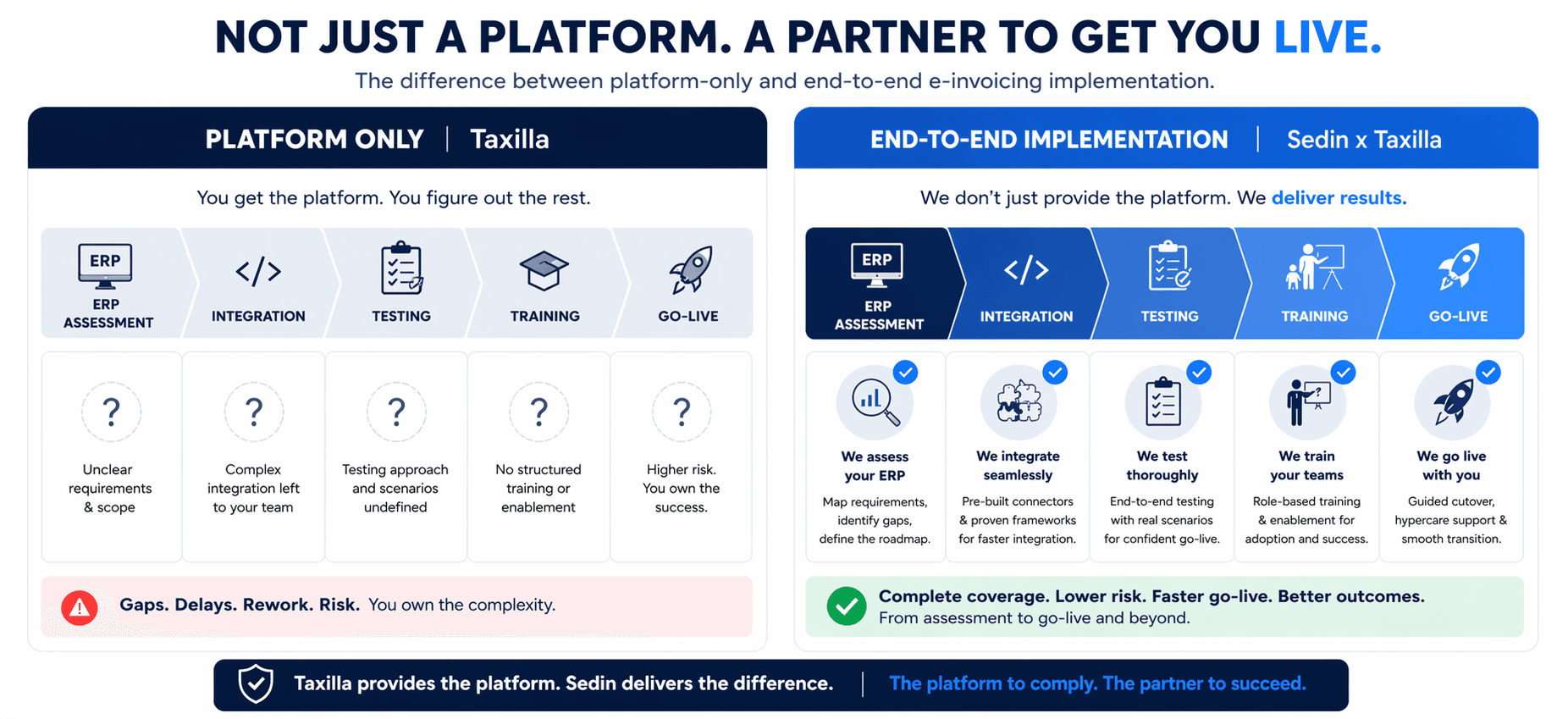
Sedin is the technology implementation partner of Taxilla—which means when you work with us, you're not buying a platform and then figuring out integration on your own. You're getting the ASP and the team that makes it work inside your business. One engagement. One accountable partner. No gap between "the software is ready" and "our invoices are flowing."
 Here's what that end-to-end engagement actually covers:
What Taxilla brings (the platform):
MoF Pre-Approved ASP. Taxilla is listed on the UAE Ministry of Finance portal as a pre-approved e-invoicing service provider and is a certified Peppol Access Point.
Multi-country, battle-tested. Active across 20+ countries including India, Saudi Arabia, Australia, New Zealand, Malaysia, Japan, and Oman. This isn't a team learning CTC for the first time—they've been through the implementation pain in markets with similar (and stricter) mandates.
Real ERP integration, not workarounds. Pre-built connectors for major ERPs with support for custom apps, accounting software, and POS systems. The integration engine supports JSON, XML, CSV, multi-file input, and custom API payloads. Translation: your finance team works in the ERP they already know. No separate portal. No manual exports.
High-volume, enterprise-grade. Handles 3M+ invoices annually across B2B and B2C segments. Multi-source data aggregation, multi-entity support, and real-time dashboards for submission tracking and exception management.
What Sedin brings (the implementation):
ERP readiness assessment. We audit your current invoicing workflow, identify gaps against PINT-AE mandatory fields, and build a clear remediation roadmap before a single line of integration code is written.
Data mapping and transformation. We map your existing invoice data structures to the PINT-AE schema—field by field, entity by entity—so Taxilla's validation engine receives clean, compliant data from day one.
Integration architecture and delivery. We design, build, and test the connector between your ERP and Taxilla's platform. Whether it's SAP, Oracle, Dynamics, or a custom setup, we own the integration end to end.
UAT, go-live, and hypercare. We run user acceptance testing with your finance team, manage the go-live cutover, and provide dedicated post-launch support to catch and resolve any edge cases in production.
Change management. Your AP/AR teams need to know what changes, what doesn't, and what to do when something flags. We handle the training and the documentation so the transition doesn't land on your finance team as a surprise.
The result: Taxilla is your ASP. Sedin is your technology partner. Together, it's a single, end-to-end delivery—from assessment to go-live to ongoing compliance.
The 90-Day Action Plan: What to Do Right Now
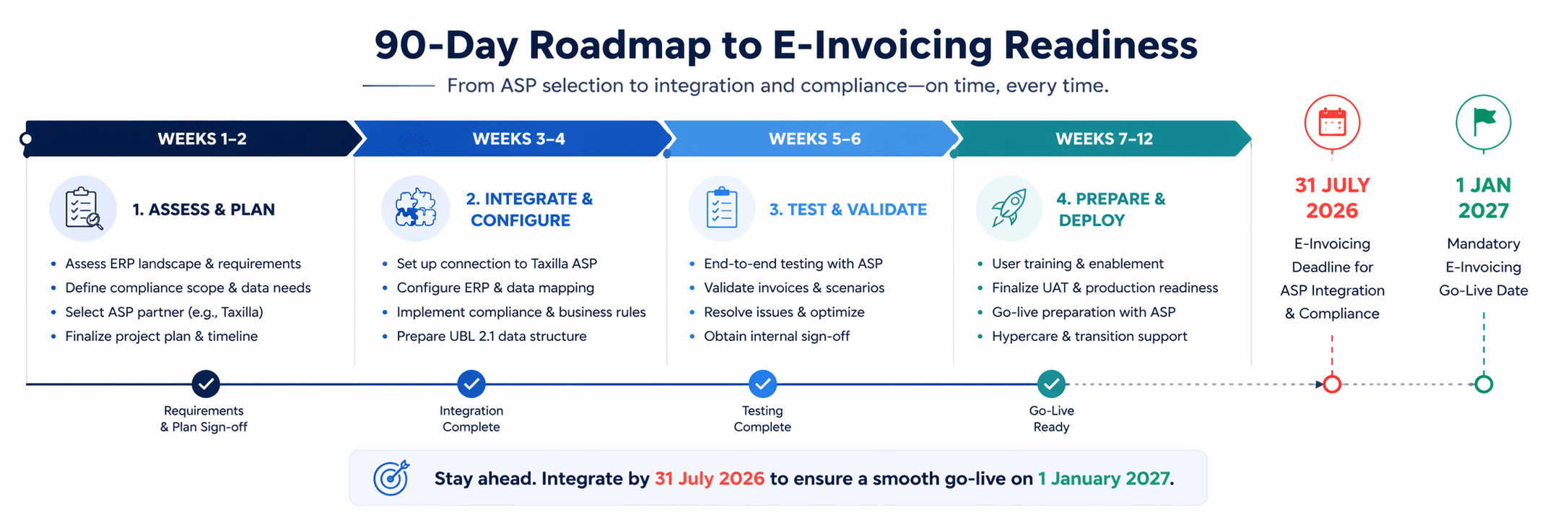
If you're a large business (AED 50M+ revenue), here's what the next 90 days should look like:
Weeks 1–2: Internal assessment. Audit your current invoicing workflow. How are invoices generated today? What ERP are you on? What data fields are captured at line level? Where are the gaps against PINT-AE mandatory fields? This is the step most businesses skip—and then pay for during integration.
Weeks 3–4: ASP evaluation. Run a structured evaluation against the criteria above. Don't just demo the portal—ask for proof of Peppol certification, reference deployments in similar ERP environments, and specific SLA commitments. Shortlist to 2-3 providers max.
Weeks 5–6: Decision and appointment. Make the call. Complete the formal appointment through the MoF portal. The earlier you lock this in, the more integration and testing time you buy yourself before the 1 January 2027 go-live.
Weeks 7–12: Integration and testing. This is where prebuilt connectors vs. generic APIs makes or breaks your timeline. With Sedin x Taxilla, you're running UAT by week 10—because the integration, data mapping, and testing are all handled under one roof. With a platform-only ASP, you're still looking for someone to do this part.
Still Evaluating? Here's What We'd Suggest.
Skip the 40-page RFP. Get on a call with our team. We'll walk through your ERP setup, your entity structure, and your invoice volumes—and map out exactly what the end-to-end journey looks like with Sedin x Taxilla.
No separate ASP vendor management. No hunting for a systems integrator after you've signed the platform. One partner, one engagement, assessment to go-live.
If we're the right fit, we can have you on a clear implementation path within a week. If we're not, we'll tell you that too.

FAQ
Can I use my existing ERP to generate e-invoices without an ASP?
No. Your ERP generates invoices, but it cannot transmit them directly to the FTA. Every business must route structured e-invoices through a certified ASP that connects to the Peppol network. Your ERP needs to integrate with an ASP—it cannot replace one.